Strength Training for Metabolism: Why It's Essential
4 min read
When people talk about improving metabolism, the conversation almost always turns to food.
What should you eat?
What should you avoid?
Should you cut carbs? Try fasting? Eat more protein?
Nutrition matters — deeply. But focusing on diet alone misses one of the most powerful metabolic levers available to you: muscle.
Strength training doesn’t just change how your body looks. It changes how your body functions, how it uses fuel, and how resilient your metabolism becomes over time.
If metabolic health is the goal, strength training stops being optional.
Your Metabolism Lives in Your Muscle
Muscle is often treated as something aesthetic — something you build to look stronger or leaner. But metabolically, muscle is far more than that.
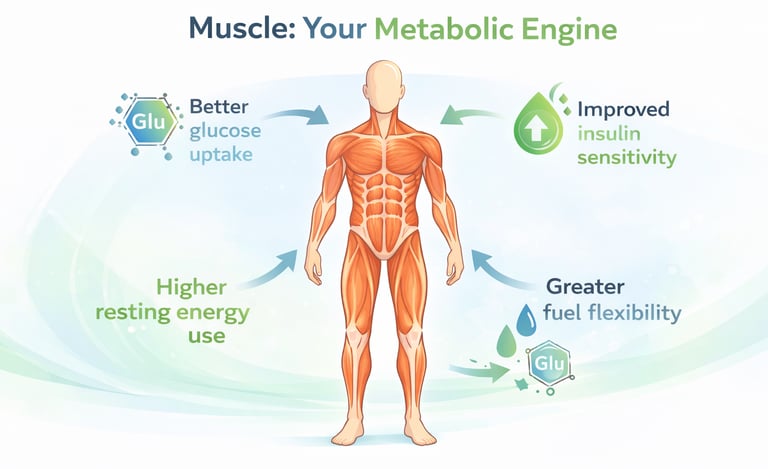
Muscle tissue acts like a sponge for glucose. After you eat, it helps pull sugar out of the bloodstream and store it where it can actually be used. The more muscle you carry, the better your body tends to handle carbohydrates.
This is one of the reasons insulin sensitivity is often higher in people who strength train consistently.
But the benefits don’t stop there.
Muscle also increases your resting energy needs. Even when you’re not moving, your body must maintain that tissue. Over time, this subtly shifts your metabolic baseline upward — not dramatically, but meaningfully.
More importantly, muscle gives your metabolism flexibility. It provides a larger “engine” capable of using both fat and glucose efficiently.
And flexibility, as we’ve seen, is the real marker of metabolic health.
Why Cardio Alone Isn’t Enough
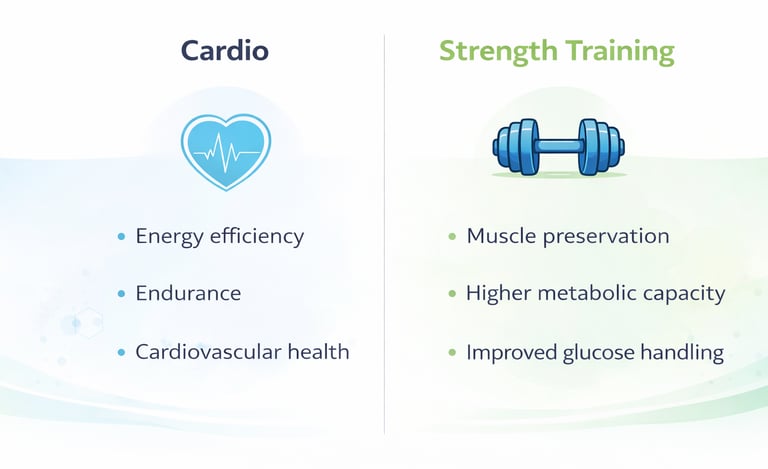
Cardio has its place. Walking, cycling, and aerobic work support heart health, improve circulation, and help regulate stress.
But when it comes to metabolism, cardio doesn’t send the same signal that strength training does.
Long sessions of steady cardio primarily teach the body to become efficient — sometimes too efficient. You burn fewer calories performing the same work over time, and the body adapts by conserving energy where it can.
Strength training sends a different message entirely.
It tells the body:
“This tissue is necessary. Keep it.”
In response, your physiology shifts toward preservation and resilience rather than conservation.
That distinction matters more than most people realize.
Muscle Protects Against Metabolic Slowdown
Many people who attempt to lose weight focus only on eating less. Without resistance training, that approach often leads to losing muscle along with fat.
When muscle decreases, metabolism tends to follow.
This is one reason aggressive dieting so often backfires. People don’t just weigh less — they become metabolically smaller.
Strength training acts as a safeguard. It signals the body to retain lean tissue, helping ensure that weight loss — if it occurs — comes more from your stubborn ass belly fat than from muscle.
Over the long term, this makes maintaining progress far more realistic.
Strength Training Improves Fuel Use
Remember the idea of metabolic flexibility — the ability to shift between fat and glucose?
Muscle plays a central role in that process.
After strength training, muscle cells become more receptive to glucose. Instead of circulating in the bloodstream, that energy is directed toward repair and replenishment.
At the same time, building muscle improves mitochondrial function — essentially enhancing the machinery responsible for producing energy inside your cells.
The result is a metabolism that responds more smoothly to both feeding and fasting states.
Not extreme. Not fragile. Just adaptable.
You Don’t Need to Train Like an Athlete
One of the biggest misconceptions about strength training is that it requires an intense or time-consuming routine.
It doesn’t.
Two to three well-structured sessions per week are enough to create meaningful metabolic benefits. The goal isn’t exhaustion — it’s consistency and progressive challenge.
Simple movements performed with control often outperform complicated programs that are difficult to sustain.
Strength training should feel like a long-term investment in your physiology, not a short burst of punishment.
What Strength Training Does That Diet Cannot
Nutrition can influence insulin levels.
It can stabilize energy.
It can help you access stored fat.
But diet alone cannot tell your body to build tissue.
Only mechanical tension — the act of challenging your muscles — creates that signal.
This is why people who rely solely on dietary strategies sometimes feel metabolically “flat” over time. The system is being managed, but not expanded.
Strength training expands it.
It raises your metabolic ceiling rather than just lowering metabolic stress.
Aging, Muscle, and Metabolic Health
Starting in early adulthood, most people gradually lose muscle if they don’t actively maintain it. The process is subtle, but its metabolic consequences compound over the years.
Less muscle often means:
Reduced insulin sensitivity
Lower energy expenditure
Greater difficulty regulating weight
Strength training interrupts this trajectory.
It is one of the most reliable ways to support metabolic health across decades — not just months.
In many ways, lifting is less about immediate results and more about protecting your future physiology.
The MetaFuel Perspective on Training
At MetaFuel, strength training isn’t framed as a fitness trend or a body transformation strategy.
It’s infrastructure.
Nutrition shapes the metabolic environment.
Strength training builds the machinery that runs inside it.
When both are present, the system becomes far more stable.
You don’t need perfection. You don’t need extreme protocols. You need a signal strong enough to tell your body that muscle is worth keeping.
Once that message is clear, many other aspects of metabolism begin to improve alongside it.
Where to Start
If you’re new to strength training, start simply.
Focus on foundational movement patterns — pushing, pulling, squatting, hinging, carrying. Allow recovery between sessions. Progress gradually.
The exact program matters far less than the habit itself.
Over time, consistency compounds into metabolic resilience.
What Comes Next
So far, we’ve explored how the body uses fuel, how dietary strategies influence metabolism, and why muscle plays such a critical role in that system.
Next, we’ll turn to a factor that quietly shapes nearly every metabolic process: sleep.
Because even the best nutrition and training plan struggles to compensate for chronic sleep disruption.
MetaFuel takeaway: Muscle isn’t just for strength. It’s one of the foundations of a healthy metabolism.