Stress and Metabolism: The Invisible Force
5 min read
Most people blame their metabolism when their energy feels unpredictable.
They look at their diet.
They question their workouts.
They wonder if something is “wrong.”
Few consider that the issue may not begin with food or fitness at all — but with the signals their body is receiving throughout the day.
Because stress is not just emotional pressure.
It is biological instruction.
Every time your brain perceives a challenge, demand, or threat — whether physical or psychological — it sends messages that influence how your body produces, stores, and uses energy.
Your metabolism is not operating in isolation.
It is listening.
Constantly.
Your Body Cannot Tell the Difference Between Deadlines and Danger
The human stress response is remarkably sophisticated. It evolved to keep us alive in moments when survival required immediate action.
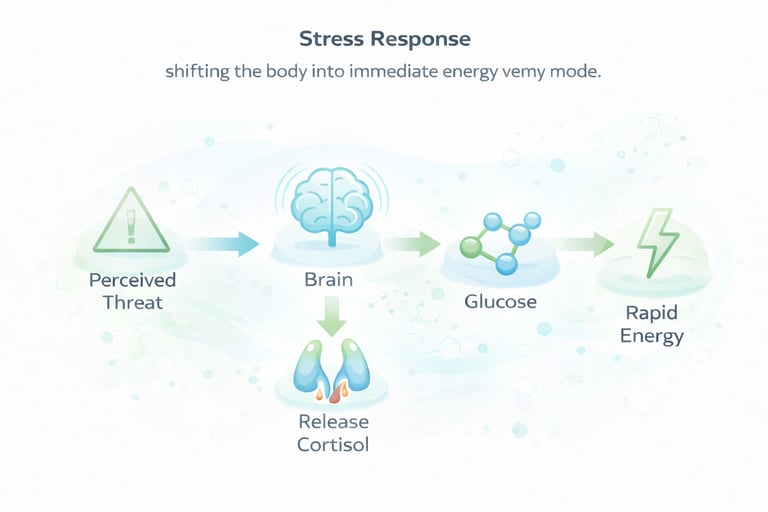
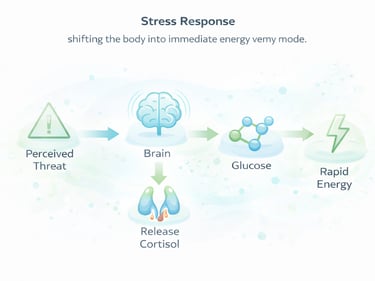
When the brain detects a threat, the body prepares almost instantly to respond.
Heart rate rises.
Alertness sharpens.
Energy becomes rapidly available.
Behind the scenes, glucose is released into the bloodstream so muscles and brain cells have the fuel they need.
In short bursts, this system is brilliant.
Without it, our species would not have lasted very long.
But here’s where modern life complicates things.
Your physiology reacts to a looming work deadline in much the same way it would react to physical danger. The source of the stress may be very different — but the metabolic response is surprisingly familiar.
The stress response is extraordinary for emergencies…
and deeply confusing when switched on all day.
Stress Is an Energy Allocation System
It helps to think of stress less as a feeling and more as a resource director.
When your brain senses pressure, it begins reallocating energy toward immediate needs. Systems related to long-term repair, metabolic optimization, and deep recovery temporarily move down the priority list.
From the body’s perspective, this makes perfect sense.
If something important is happening now, energy should be available now.
Your metabolism is constantly making this calculation — often without you noticing.
Performance now, or resilience later?
Ideally, the body moves fluidly between these states. But when stress becomes chronic, that flexibility begins to narrow.
The system stops visiting emergency mode…
…and starts living there.
Cortisol Isn’t the Villain People Think It Is
Cortisol tends to get terrible press. It’s often described as the hormone you want to “lower,” as if it were purely harmful.
In reality, cortisol is essential.
It helps regulate blood sugar, supports wakefulness, participates in immune function, and ensures energy is available when needed. You rely on it every single day.
The problem is not cortisol itself.
The problem is chronic elevation without adequate recovery.
Cortisol is protective in moments — but disruptive when constant.
Imagine leaving the lights on in your house for weeks without ever turning them off. Eventually, the system overheats.
Your physiology operates similarly. It is designed for rhythm — activation followed by recovery.
Remove the recovery, and the balance begins to drift.
Why Chronic Stress Keeps Glucose Circulating
When stress persists, the body leans toward caution.
One way it does this is by keeping more glucose available in the bloodstream. Accessible energy feels safer to a system preparing for continued demand.
From a survival standpoint, this is intelligent.
From a modern metabolic perspective, it can become inefficient.
Over time, consistently elevated glucose means insulin has more work to do. Cells may gradually become less responsive, requiring a stronger signal to manage the same task.
Nothing dramatic happens overnight. The shift is subtle — almost polite.
But metabolism is shaped by patterns, not single events.
When the pattern says “stay prepared,” the body listens.
Stress Doesn’t Always Burn Energy — Sometimes It Conserves It
Many people assume stress should increase energy expenditure. After all, it feels activating.
Yet the body often responds differently.
A chronically stressed system prefers predictability. It becomes less eager to release stored fuel and more interested in maintaining stability.
You could think of it as metabolic risk management.
A stressed system prefers predictability over metabolic risk.
This is one reason progress can feel harder during prolonged periods of pressure. It isn’t necessarily a failure of effort — it’s the body responding intelligently to the environment it believes you are living in.
Stress and Sleep: A Two-Way Conversation
Stress rarely stays contained to waking hours. Elevated alertness tends to follow us into the night, subtly interfering with the depth and quality of sleep.
And insufficient sleep, in turn, makes the nervous system more reactive the next day.
The result is less like a straight line and more like a loop.
Sleep and stress don’t compete — they inform each other.
When one improves, the other often follows. When one erodes, the system becomes more sensitive overall.
Supporting metabolism means supporting both sides of this conversation.
Stress Influences Muscle More Than You Might Expect
Muscle plays a central role in metabolic health, helping regulate glucose and expand your capacity to use fuel effectively.
But muscle is also responsive to the broader environment — including stress.
When the body senses prolonged strain, recovery signals can soften. Adaptation may slow. Fatigue can linger longer than expected.
This isn’t the body malfunctioning.
It’s the body protecting itself.
Once again, the system is choosing safety.
Understanding this helps shift the narrative from frustration to interpretation. Instead of asking, “Why isn’t this working?”, it becomes more useful to ask, “What signals is my body receiving?”
Modern Stress Is Often Invisible
Very few of us are outrunning predators.
Yet the nervous system remains highly responsive to perceived demand.
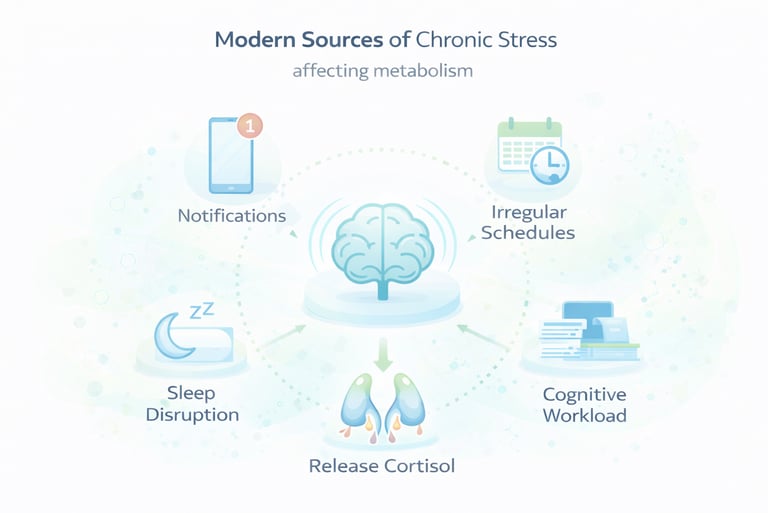
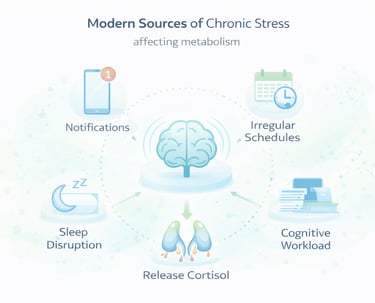
Today’s stressors are often quieter but remarkably persistent:
constant notifications,
dense schedules,
irregular routines,
information that never quite stops arriving.
Your nervous system doesn’t particularly care whether the pressure comes from physical danger or an overflowing inbox. It simply registers activation and adjusts physiology accordingly.
The challenge is not that stress exists — it always has.
The challenge is accumulation without sufficient reset.
Can You Improve Metabolism Without Addressing Stress?
It’s tempting to believe that disciplined nutrition can override everything else.
And thoughtful eating does matter — enormously.
But physiology is collaborative. Systems influence each other whether we acknowledge it or not.
You can eat well. Train consistently. Make smart decisions.
Yet if the body continually receives signals that the environment is demanding or unpredictable, it behaves defensively.
Metabolism responds to the environment it believes you are living in.
Support that environment, and many processes become smoother. Ignore it, and progress often feels unnecessarily uphill.
What Actually Helps Regulate the Stress Response
There is no need to turn stress regulation into a complicated project. In fact, the nervous system tends to respond best to simple, repeatable signals.
Rhythm helps. Predictable sleep helps. Regular movement helps. Moments of genuine recovery help.
None of these are dramatic interventions — and that’s precisely why they work.
The nervous system relaxes when life becomes more predictable.
Perfection isn’t required. What matters is giving the body enough evidence that it is safe to shift out of constant alertness.
Over time, metabolism follows that lead.
The MetaFuel Perspective
Stress is not the enemy of metabolic health. It is part of being human.
The real challenge is unresolved, continuous activation — the kind that leaves the body preparing without ever fully recovering.
When the system senses safety, it allocates energy differently. Repair rises on the priority list. Fuel usage becomes more efficient. Flexibility returns.
Metabolic health is not built by removing pressure from life…
…but by helping the body respond to it more intelligently.
Looking Ahead
So far at MetaFuel, we’ve explored how the body chooses fuel, how muscle expands metabolic capacity, how sleep stabilizes recovery, and now how stress shapes the entire landscape.
Next, we’ll examine another quiet driver of metabolic health:
metabolic flexibility — the ability to adapt smoothly between fuel sources.
Because resilience, more than intensity, is what allows the system to thrive.
MetaFuel Takeaway:
Your metabolism is always listening to the signals around you.
When those signals shift toward safety and rhythm, energy tends to follow.