Why Your Body Finds Sleep Stressful (Garmin & Oura)
4 min read
Listen, we've all been there. You drag yourself out of bed, feeling like you actually caught some decent Z's, only to check your Garmin and see a wall of red bars. Your "Stress Score" is through the roof, and your "Body Battery" looks like an iPhone that's been sitting in a drawer since 2012.
Welcome to the world of Orthosomnia - the anxiety-driven obsession with achieving perfect sleep metrics. It's a very real 2026 phenomenon where, ironically, the stress of trying to optimize your sleep score actually makes your sleep worse, creating a vicious cycle that your wearable dutifully tracks in bright red graphs. If you've ever asked, "Why does my body find sleeping so stressful?" you aren't alone. In fact, search interest in "High stress scores during sleep on Garmin" has hit an all-time high, even though the competition to explain it remains surprisingly low.
Here's the science of why your wearable thinks you're running a marathon while you're actually dreaming about a sandwich.
What "Stress" Actually Means (Hint: It's Not Your Boss)
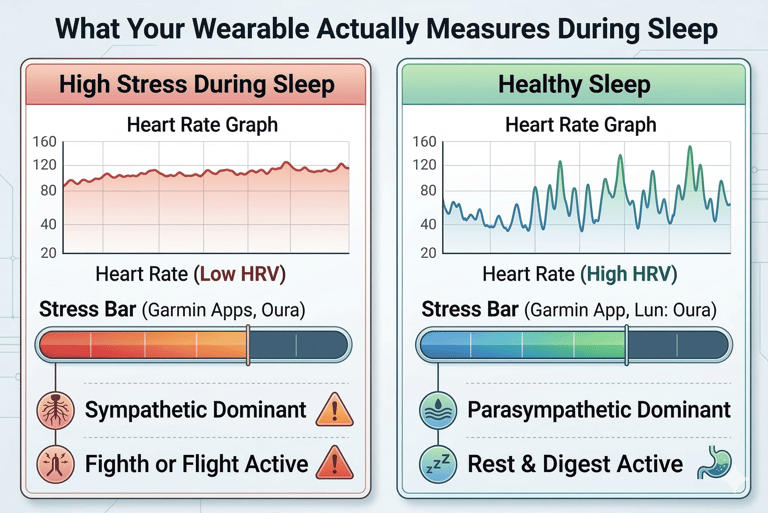
On devices like Garmin or Oura, "stress" isn't measuring your emotional state or how annoyed you are at your boss. It's tracking something called Heart Rate Variability (HRV) - basically, the tiny variations in timing between your heartbeats. Counterintuitively, more variation is actually better. Here's why.
Think of your autonomic nervous system like a tug-of-war between two opposing forces:
The Accelerator (Sympathetic Nervous System): Your "Fight or Flight" mode. When this is dominant, your heart rate becomes steady and predictable, which means low HRV. Your body is on high alert, prioritizing survival over recovery.
The Brake (Parasympathetic Nervous System): Your "Rest and Digest" mode. When this is in control, it creates healthy, chaotic variations between beats, which means high HRV. Your body feels safe enough to actually recover and repair itself.
When your wearable shows high stress at 3:00 AM, it means your "accelerator" is floored even though you're asleep. Your body is in a state of physiological hyperarousal, treating sleep like it's a threat rather than a chance to recharge.
The 4 Hidden "Sleep Saboteurs"
If your wearable constantly shows red bars during sleep, one of these "low-key" culprits is likely the cause:
1. The Late-Night Protein Bomb
Digestion is hard work. If you eat a high-protein meal too close to bed, your body spends the first four hours of sleep doing metabolic heavy lifting, keeping your heart rate up and your HRV down. Your digestive system doesn't care that you're trying to rest - it's got a job to do, and it's going to use a lot of energy doing it.
2. The "Worry Gene" Activation
Anticipatory anxiety about tomorrow's meetings can trigger your HPA axis (your body's stress control center) even while you're asleep. Your conscious mind might be dreaming about sandwiches, but your unconscious is already rehearsing that presentation, spiking cortisol and tanking your recovery.
3. The Alcohol Trap
Even one glass of wine can cause a stress spike lasting 4-6 hours, effectively preventing your body from entering deep, restorative sleep stages. Alcohol might help you fall asleep faster, but it absolutely destroys the quality of that sleep - and your wearable will show you the receipts in the morning.
4. Subclinical Illness
Your Garmin often knows you're getting sick before you do. A sudden, unexplained spike in nighttime stress is a classic signal that your immune system is working overtime fighting off an infection. If you see red bars with no obvious cause, there's a decent chance you'll be sniffling in 24-48 hours.
The Hormone Loop: Why Your "Body Battery" Won't Recharge
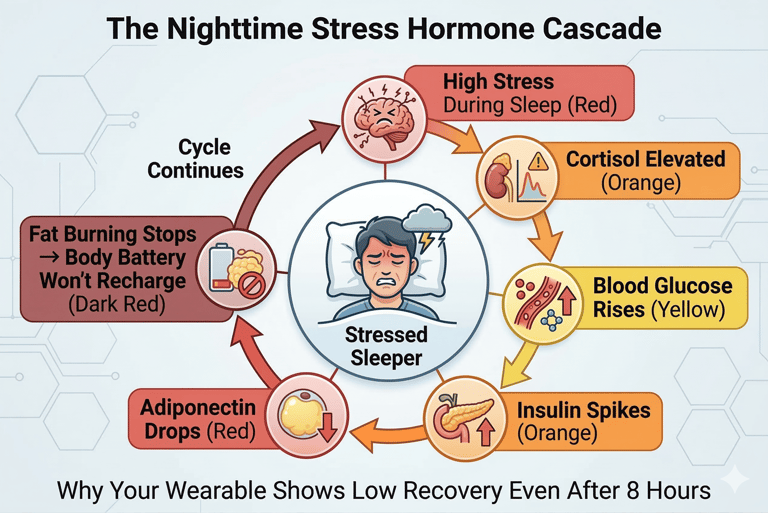
When your body stays in a high-stress state overnight, it triggers a hormonal chain reaction that makes weight loss and muscle recovery nearly impossible.
Here's what happens: High cortisol during sleep → High glucose → High insulin → Low adiponectin (the hormone that helps you burn fat).
This is why you can't diet your way out of poor sleep - your biology is biochemically locked in survival mode. When cortisol stays elevated all night, your body thinks you're in danger, so it holds onto every calorie like you might need it to outrun a predator. Meanwhile, your insulin levels stay high, your fat-burning hormones drop, and your "Body Battery" refuses to recharge no matter how many hours you spend in bed.
The 2-Minute Fix: Micro-Interventions
You don't need a $10,000 mattress or a 12-step bedtime routine. You just need to manually flip the switch from the accelerator to the brake. Here are three interventions that actually work:
The Vagus Nerve Reset: Before you close your eyes, try a simple vagus nerve massage (gently massaging the sides of your neck) or even humming a low note for 30 seconds. This sends a physical signal to your brain that the environment is safe, shifting you into "Rest and Digest" mode. It sounds weird, but your wearable will show you it works.
The Digital Sunset: New 2026 guidelines suggest a "digital sunset" at least 60 minutes before bed. It's not just about blue light anymore - it's about stopping the scroll-induced dopamine hits that keep your nervous system on high alert. Every notification, every swipe, every "just one more video" tells your brain the day isn't over yet.
Box Breathing (4-4-4-4): Inhale for 4 seconds, hold for 4 seconds, exhale for 4 seconds, hold for 4 seconds. Repeat for 2-3 minutes. It's the quickest way to lower your heart rate and see that Garmin graph turn from red to blue. This technique literally activates your parasympathetic nervous system on command.
The Bottom Line: Use Data, Don't Obey It
The goal for 2026 isn't to hit a perfect sleep score every night. It's to use your wearable as a conversation starter with your body, not a report card. If your Body Battery isn't recharging, don't panic - just look at your late-night habits, try a 2-minute micro-intervention, and remember: your intuition is still more powerful than any algorithm.
Your Garmin can tell you when something's off, but only you can feel what your body actually needs. Sometimes that's better sleep hygiene. Sometimes it's addressing the stress that's been building all week. And sometimes it's just ignoring the red bars and trusting that you're doing fine.