Why You Crash After Eating Carbs (And How to Stop It)
4 min read
You finish a meal expecting energy…
…and instead feel like someone quietly dimmed the lights.
Your focus softens. Motivation fades. Sometimes the idea of a nap becomes unusually persuasive.
If this sounds familiar, you’re not imagining it — and your metabolism isn’t broken.
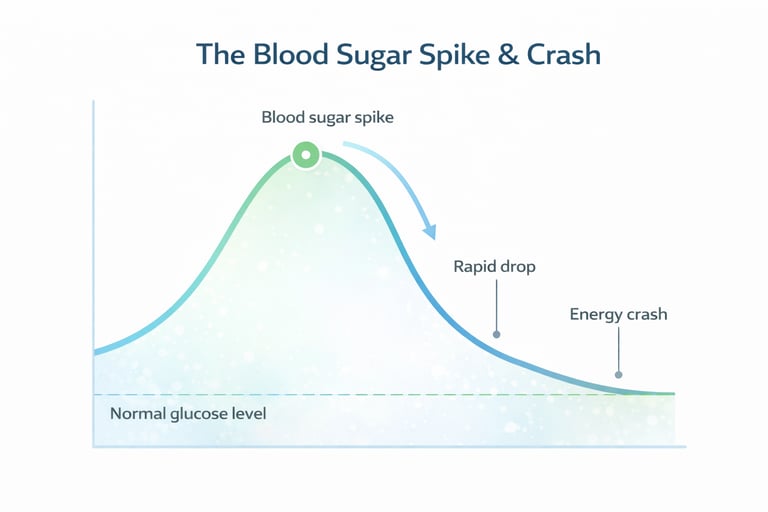
What many people call a “carb crash” is actually a very predictable biological response. It happens when blood sugar rises quickly, insulin moves in to manage it, and energy availability shifts just as fast.
Understanding why this happens is the first step toward preventing it.
Because once you understand the signal, you can change the response.
What a Carb Crash Actually Is
After you eat carbohydrates, they are broken down into glucose — the primary fuel your body uses for immediate energy. That glucose enters the bloodstream, prompting the release of insulin, a hormone that helps move sugar into your cells where it can be used.
Ideally, this process is smooth and steady.
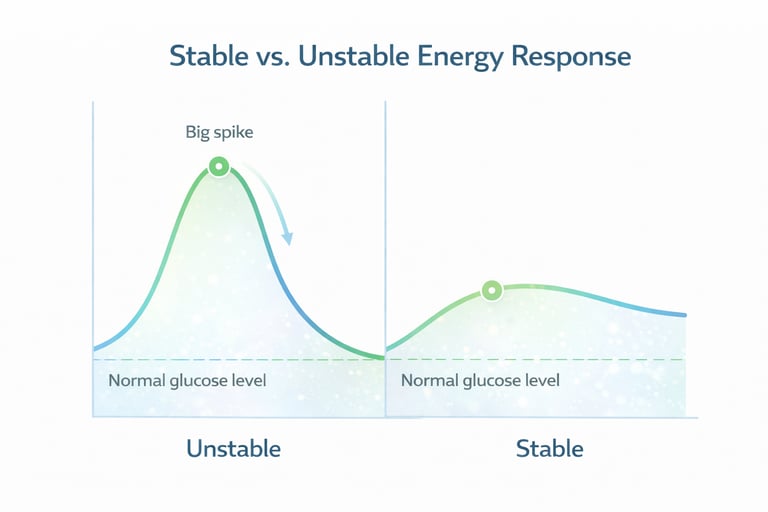
But when glucose rises rapidly, the body often responds just as quickly - because if it doesn't the body risks entering a coma-. Insulin works efficiently to lower blood sugar asap, sometimes causing it to fall faster than expected. The result can feel like an abrupt dip in energy — not dramatic, but noticeable enough to change how you feel.
Energy crashes are rarely about the carbs alone. More often, they reflect how quickly your metabolism is being asked to react.
Your physiology prefers gradual transitions. Rapid spikes force rapid corrections.
Your Body Isn’t Making a Mistake
It’s tempting to interpret an energy crash as a sign that something is wrong. In reality, your metabolism is doing exactly what it was designed to do: regulate fuel so your cells remain supplied without allowing blood sugar to stay elevated for too long.
Your system is protecting you,
Think of it less like a malfunction and more like an overcorrection — the metabolic equivalent of tapping the brakes a bit too firmly.
When everything moves at a reasonable pace, energy tends to feel stable. When things accelerate, the body accelerates with them.
And speed is often the real story here.
The Most Common Trigger: Fast-Digesting Carbs on Their Own
Not all carbohydrate meals behave the same way.
Meals built mostly around refined or fast-digesting carbs — especially when eaten alone — can enter the bloodstream quickly. Without protein, fat, or fiber to slow digestion, glucose rises faster, and insulin has to act decisively.
Fast rise. Fast correction.
That’s the pattern many people experience.
This doesn’t mean carbohydrates are inherently problematic. It simply means the metabolic context matters.
Your body handles fuel best when it arrives at a pace it can comfortably manage.
Sleep Quietly Shapes Tomorrow’s Energy
If you’ve ever noticed stronger crashes after a poor night of sleep, that observation is more insightful than you might think.
Sleep plays a meaningful role in insulin sensitivity — essentially how responsive your cells are to insulin’s signal. When sleep is shortened or fragmented, that responsiveness can soften. The body has to work harder to regulate glucose, and the swings can feel more pronounced.
A tired metabolism is often a less predictable one.
This is one reason energy stability begins long before the first meal of the day.
Stress Is Amplifying the Swing
Stress doesn’t reset when you sit down to eat. Your metabolic state carries the imprint of your entire day.
When stress hormones -Including Cortisol- circulate, the body tends to keep more glucose available in the bloodstream — a built-in preparation strategy in case energy is needed quickly, like a defense mechanism. Add a carbohydrate-heavy meal on top of that, and the system has more to juggle.
Metabolism doesn’t operate in isolated moments. It responds to the broader environment.
When that environment feels stressful, the body leans toward caution — sometimes creating larger energy fluctuations than expected.
Muscle Changes the Equation
Muscle tissue plays an underrated role in energy stability. One of its many responsibilities is helping absorb glucose from the bloodstream, directing it toward storage and use rather than letting it circulate indefinitely.
The more metabolically active tissue you carry, the more space glucose has to go.
This doesn’t mean you need to train like an athlete. It simply highlights how the body is designed: muscle supports fuel regulation.
And when fuel is handled smoothly, energy tends to feel smoother too.
How to Prevent Carb Crashes — Without Going Extreme
The solution isn’t eliminating carbohydrates or adopting rigid food rules. More often, it’s about creating conditions that encourage steadier metabolic responses.
Combining nutrients is a powerful place to start. Pairing carbohydrates with protein, fat, or fiber slows digestion and moderates how quickly glucose enters the bloodstream.
Eating in a calmer metabolic state helps as well — which circles back to sleep and stress. A well-rested, less reactive system tends to manage fuel more gracefully.
Even gentle movement after meals can support this process. Something as simple as a short walk encourages muscles to use incoming glucose, smoothing the overall curve.
Stability is what your metabolism is always trying to create. Your daily patterns can either support that goal… or unintentionally compete with it.
Do Carb Crashes Mean You Should Avoid Carbs?
For most people, no.
Carbohydrates are one of the body’s most efficient energy sources, particularly for the brain and for physical activity. The real objective is not elimination — it’s adaptability.
A metabolically flexible system can use carbohydrates when they are available and shift toward fat when needed, without dramatic swings in energy.
The goal isn’t restriction.
It’s resilience.
When to Pay Closer Attention
Occasional dips in energy are part of being human. But if crashes feel intense, frequent, or disruptive to daily life, it may be worth exploring the pattern more closely with a qualified professional.
Metabolism is nuanced, and persistent symptoms deserve thoughtful attention.
Most of the time, though, small adjustments create meaningful change.
The MetaFuel Perspective
Carb crashes are not a sign that your metabolism is failing.
More often, they are a sign that your system is being asked to react faster than it prefers.
Your metabolism is constantly working to maintain balance — adjusting hormones, directing fuel, and protecting your cells. When the signals it receives become steadier, the responses usually follow.
Support smoother inputs, and energy often becomes smoother too.
Because in the end, metabolic health is less about dramatic interventions…
…and more about creating conditions the body recognizes as stable.
MetaFuel Takeaway:
Your metabolism doesn’t just respond to what you eat — it responds to the pace at which energy arrives. Slow the spike, and you often soften the crash.