The Best Time to Eat for a Faster Metabolism (It’s Not When You Think)
You’ve spent years tracking calories, swapping carbs, cutting sugar. And maybe it helped — or maybe your metabolism just shrugged and carried on doing whatever it wanted. Here’s something nobody talks about enough: it’s not just what you eat. It’s when.
Your body runs on a clock. A literal 24-hour biological timer that controls how you burn fat, absorb glucose, store energy, and feel human. And most of us are eating completely out of sync with it — then wondering why the scale won’t budge.
The good news? You don’t need a new diet. You might just need a new schedule.
What Even Is Circadian Eating?
Your circadian rhythm is your body’s internal clock — the one that tells you when to sleep — which is one of the biggest levers on your metabolism, when to wake up, and (this is the part people miss) when your metabolism is actually ready to do its job.
Here’s what that clock controls beyond just sleep:
How sensitive your cells are to insulin — which determines how much fat you store and how badly you crash after high-carb meals
When your digestive enzymes peak (hint: not at 9 PM)
Cortisol patterns that affect where your body holds fat
How efficiently you convert food into energy vs. storing it for “later”
Circadian eating — sometimes called chrononutrition or the circadian reset diet — is simply the practice of eating in sync with those peaks instead of against them. Eat more when your body’s ready to burn it. Eat less when it’s winding down.
Simple in theory. Wildly effective in practice.
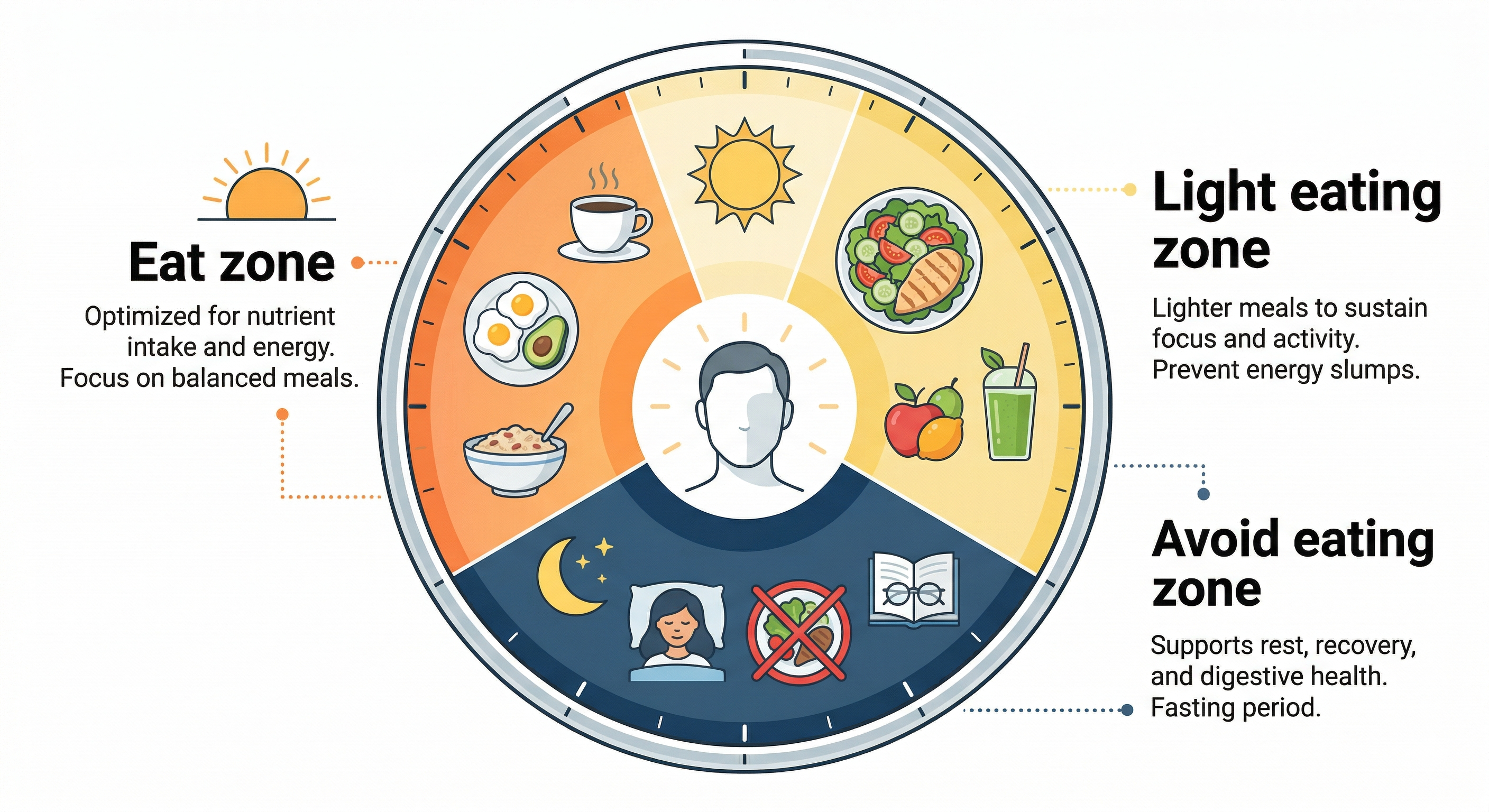
The 3 metabolic zones of your day — and when your body burns best
What the Research Actually Says
Let’s skip the “studies suggest” vagueness and get to the actual findings.
A 2025 review in Nutrients compared people who front-loaded their calories (big breakfast, lighter dinner) versus people who ate the same total calories but concentrated them at night. Same food. Different timing. The front-loaders lost more weight and had significantly better insulin sensitivity. Not a little better — noticeably better.
ScienceDaily published research confirming that insulin and IGF-1 — two hormones that directly control fat storage — sync tightly with your circadian rhythm. Your morning cells are primed to absorb glucose and burn it. Your evening cells are basically closed for business.
And a 2026 study on what’s now going viral as “reverse fasting” found metabolic improvements in people who shifted their eating window earlier — without changing a single thing about what they ate.
That last one is worth sitting with. Same food. Better results. Just because of timing.
Your Day Has 3 Metabolic Zones
Think of your day in three phases — not based on hunger, but on what your body is actually capable of at each point:
Zone 1: The Power Window (7 AM – 12 PM)
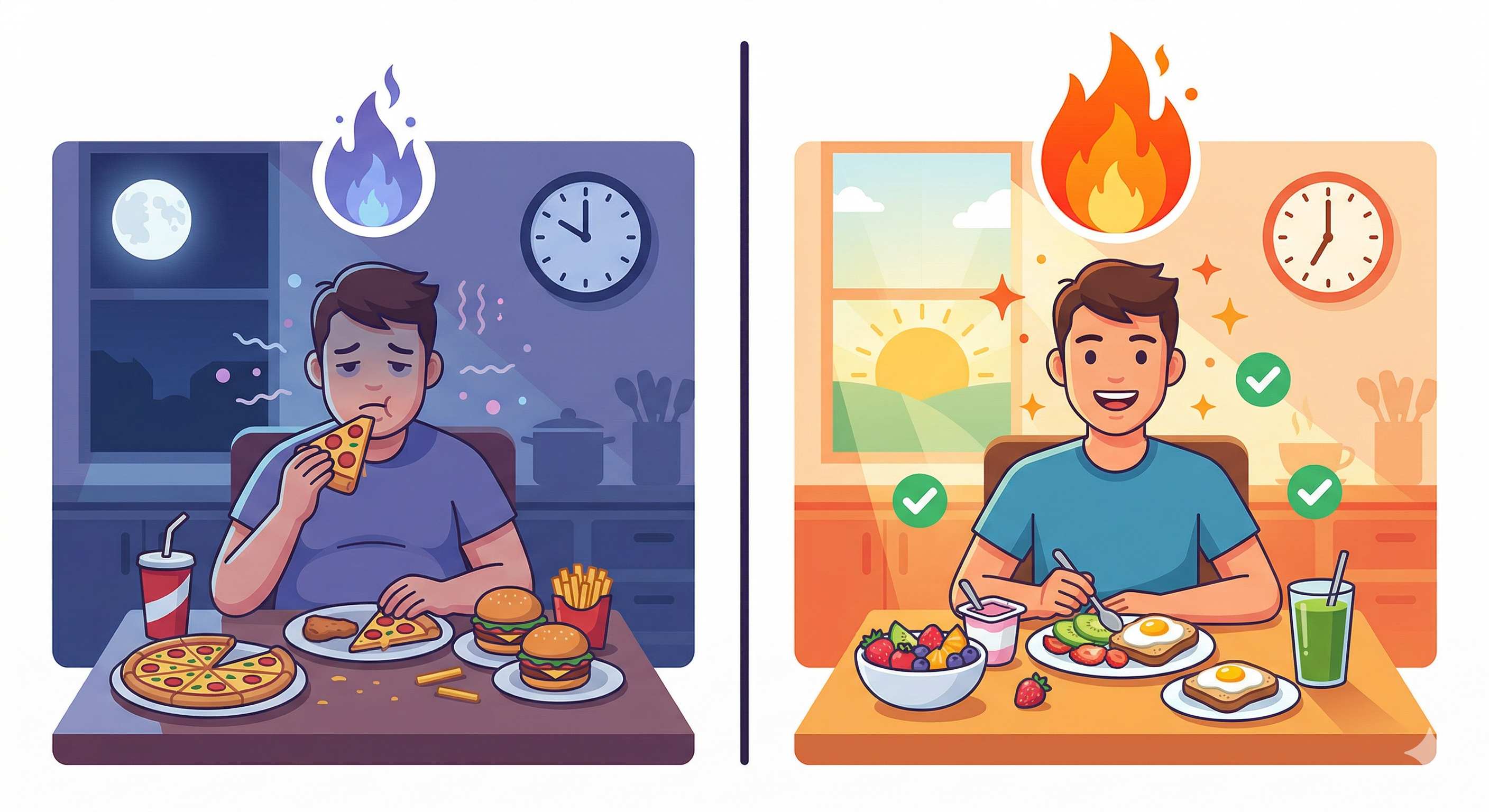
This is when your insulin sensitivity is at its peak. Your digestive system is firing on all cylinders. Your body genuinely wants to process food right now — so give it the most to work with. Big breakfast, quality protein, complex carbs. This is not the meal to skip.
Zone 2: The Maintenance Window (12 PM – 5 PM)
Still good. Metabolism is active, lunch fits perfectly here, snacks are fine. Your body is in cruise control — burning steadily, not storing aggressively. This is the comfortable middle ground most people are already in.
Zone 3: The Wind-Down Window (5 PM – bedtime)
This is where things go sideways for most people. Insulin sensitivity drops sharply after 5–6 PM. Your digestive system is slowing. A heavy meal at 8 PM doesn’t get burned — it gets stored. Keep dinners light if fat loss is the goal, and try to finish eating at least 3 hours before bed.
The Viral Flip: What Is “Reverse Fasting”?
If you’ve been on wellness TikTok lately, you’ve probably seen “reverse fasting” or the “sun cycle diet” everywhere. It’s blowing up — and for once, the hype is actually backed by real science.
Traditional intermittent fasting (16:8) usually looks like this: skip breakfast, eat from noon to 8 PM, fast the rest. It works for some people. But it’s also completely backwards from how your metabolism functions.
Reverse fasting flips it:
Eat your first meal early — 7 to 9 AM
Keep your eating window in the morning and afternoon
Finish your last meal by 4–6 PM
Fast through the evening and overnight
You’re still fasting for 14–16 hours. But you’re doing it during the hours when your body was going to store everything anyway. That’s the whole trick.
Same calories. Completely different outcome — depending on when you eat them.
How to Actually Start (Without Overhauling Your Life)
You don’t need to go full sunrise-eating-window on day one. Here’s a realistic starting point:
Eat within an hour of waking up. Skipping breakfast doesn’t make you a fat-burning machine — it just delays your metabolic warm-up.
Make lunch the main event. Dinner has been getting too much credit for too long. Shift your biggest meal to midday and watch how differently you feel by evening.
Pick a kitchen close time. Start with 8 PM. Then 7 PM. Give your body a few hours of nothing before bed.
Track your window. Apps like Zero make this effortless — you just log when you start and stop eating. No calorie counting needed.
Protein first in the morning. And consider cooling your carbs overnight — resistant starch keeps glucose curves flatter whatever time you eat. Eggs, Greek yogurt, a protein shake — whatever works. It keeps you full longer and kickstarts thermogenesis, which is just a fancy word for your body burning calories to digest food.
What to Eat in Each Zone
Time of DayBest FoodsWhy It WorksMorningEggs, oats, Greek yogurt, berriesHigh insulin sensitivity — your body will actually use this fuelMiddaySalmon, quinoa, leafy greens, olive oilAnti-inflammatory, keeps energy steady through the afternoonEarly eveningLight soups, vegetables, lean proteinEasy to digest as your metabolism starts winding downAvoid at nightHeavy pasta, alcohol, sugary dessertsYou’re spiking insulin at the worst possible time
Supplements That Play Well With Your Clock
Food timing is the foundation — but a few supplements can genuinely support what you’re doing:
Magnesium glycinate — taken at night, it improves sleep quality, and good sleep is one of the most underrated metabolic levers there is
Berberine — often compared to metformin for its ability to regulate blood sugar and improve insulin response. Worth researching if metabolic health is a priority.
Ashwagandha — lowers cortisol, which directly affects where your body holds fat (spoiler: high cortisol = belly fat)
Vitamin D3 + K2 — affects insulin sensitivity and is involved in the expression of circadian clock genes. Most people are deficient anyway.
Is This Just Another Wellness Trend?
Fair question. The wellness industry has made a lot of promises over the years that didn’t exactly pan out.
But circadian eating is different from most trends because it’s not asking you to do something new — it’s asking you to stop fighting your own biology. The research on chrononutrition has been building for over a decade. The “reverse fasting” viral moment is just the mainstream finally catching up.
That said — let’s be honest. If you eat 3,000 calories of garbage between 7 AM and 3 PM, the timing won’t save you. Circadian eating amplifies a decent diet. It doesn’t rescue a terrible one.
The Bottom Line
Your metabolism isn’t broken. It might just be confused — because you’ve been feeding it on a schedule that doesn’t match how it actually works.
Eat more in the morning. Eat lighter as the day goes on. Stop eating a few hours before bed. That’s the whole framework. You don’t need a new food plan — you need a new timeline.
The next time someone tells you what to eat, ask them when too. Your body’s been waiting for that question.
Sources: Nutrients (2025), ScienceDaily, Sleep Foundation, MDPI Chrononutrition Review (2025)
Frequently Asked Questions
What is the best time of day to eat for metabolism?
Research on circadian nutrition consistently shows that eating earlier in the day — aligning meals with daylight hours — produces better metabolic outcomes. Insulin sensitivity is highest in the morning and declines through the day, meaning the same meal eaten at 8am causes a smaller blood sugar response than at 8pm.
Is it bad to eat late at night?
Late eating disrupts circadian rhythm and reduces insulin sensitivity. Studies show that people who eat more calories earlier in the day lose more weight and have better metabolic markers than those who eat the same calories later, even when total intake is identical.
Does intermittent fasting improve metabolism?
Time-restricted eating (a form of intermittent fasting) has shown benefits for insulin sensitivity, blood pressure, and body composition in multiple trials. The benefit appears to come largely from aligning eating windows with daylight hours rather than from caloric restriction alone.
Related Articles
- Fibermaxxing: The Viral Gut Trend That Actually Has Science Behind It
- Sleep and Metabolism: The Factor Most People Ignore
- What Metabolism Really Is (And Why Most Advice Fails)
- The Carb-Cooling Trick: How Cooling Rice and Pasta Actually Changes Your Blood Sugar
- Why Do I Get Brain Fog After Eating?
Sources
- Sutton EF et al. (2018). Early time-restricted feeding improves insulin sensitivity. *Cell Metabolism*.
- Gill S & Panda S (2015). A smartphone app reveals erratic diurnal eating patterns in humans. *Cell Metabolism*.